
RO care guide
When Should RO Filters Be Replaced? A Practical Guide
There is no universal replacement interval for every RO purifier. Filter condition depends on feed-water quality, household consumption, purifier configuration and maintenance history. A condition-led assessment is more reliable than replacing every stage together by default.
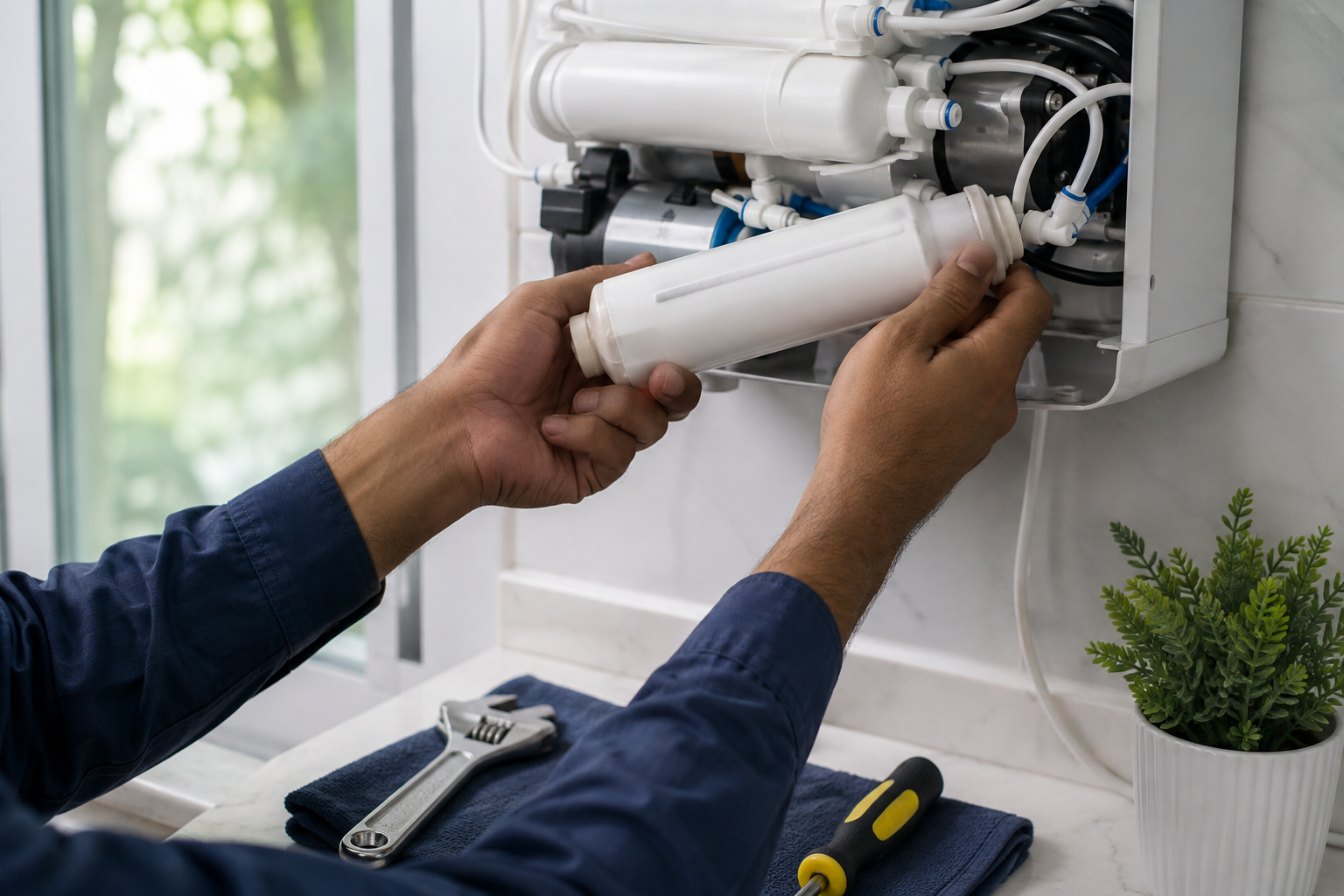
Why fixed replacement schedules can be misleading
Two homes using the same purifier can experience very different filter life. One may receive relatively clear municipal water while another receives high-turbidity borewell or tanker water. Daily consumption, inlet pressure and seasonal changes also affect how quickly filtration stages load.
A calendar reminder is useful for inspection, but it should not be treated as proof that every filter or membrane has failed. The service record and measured performance should support the replacement decision.
Sediment filter: what it does and what to assess
The sediment stage protects downstream components by trapping suspended particles. Reduced pressure after the stage, heavy visible loading where inspection is possible, and repeated pre-filter blockage may indicate that replacement is due.
A very dirty sediment filter can restrict flow, but appearance alone does not explain every problem. The incoming water supply, external spun candle, housing and tubing should also be considered.
Carbon filters: condition depends on water and design
Carbon stages are used for chlorine, odour and selected organic compounds according to the purifier design. Their useful life varies with water chemistry and volume processed. Taste or odour change may justify inspection, but these symptoms can also involve the tank, membrane or stagnant water.
Use compatible filter specifications recommended for the purifier configuration. A technician should check flow direction, fittings and flushing requirements during replacement.
RO membrane replacement needs performance checks
The membrane should not be replaced simply because the sediment or carbon filters are due. Useful checks can include feed and purified-water TDS, rejection performance, pressure, production rate and reject-water flow. Results must be interpreted together.
TDS is not a complete water-safety test, and a lower number is not automatically better for every situation. The meter helps assess dissolved solids and membrane performance; it does not identify bacteria or every contaminant.
Pre-filter spun candle and other stages
An external spun candle often receives the first load of visible sediment and may require inspection more frequently than internal filters in areas with muddy or variable water. Replacement frequency should follow actual condition and water source.
Mineral, alkaline, UV and UF stages have different functions and compatibility requirements. They should not be grouped under one generic replacement rule. Ask what each proposed part does and why it is being recommended.
Build a useful maintenance record
Keep the invoice or service record with the date, part name, specification and reason for replacement. Note the water source and any measured readings. This history helps identify unusually short life, repeat failures or a mismatch between the purifier and local water conditions.
Before chargeable work, request an inspection and estimate. Aquafresh RO Service provides independent multi-brand service across approved Delhi NCR areas, subject to purifier compatibility and local availability.
Frequently asked questions
How often should RO filters be checked?+
Inspection timing depends on the purifier, usage and water source. Follow the manufacturer configuration and arrange earlier inspection if flow, taste, odour or performance changes.
Should sediment, carbon and membrane always be changed together?+
No. Each stage has a different function and should be assessed for condition and performance.
Is TDS alone enough to decide membrane replacement?+
No. TDS rejection, pressure, production rate, reject flow and purifier configuration should be considered together.
This article provides general information and does not replace purifier-specific diagnosis or water-quality laboratory testing.